Abstract
Method
 Overview of our pipeline. BAENet predicts the exposure times of each burst image from a preview image. Differentiable Burst Simulator generates burst images according to the exposure times. The restoration network then reconstructs a high-quality image from them. During inference, the simulator is removed, and the restoration network processes real burst images captured by our camera system.
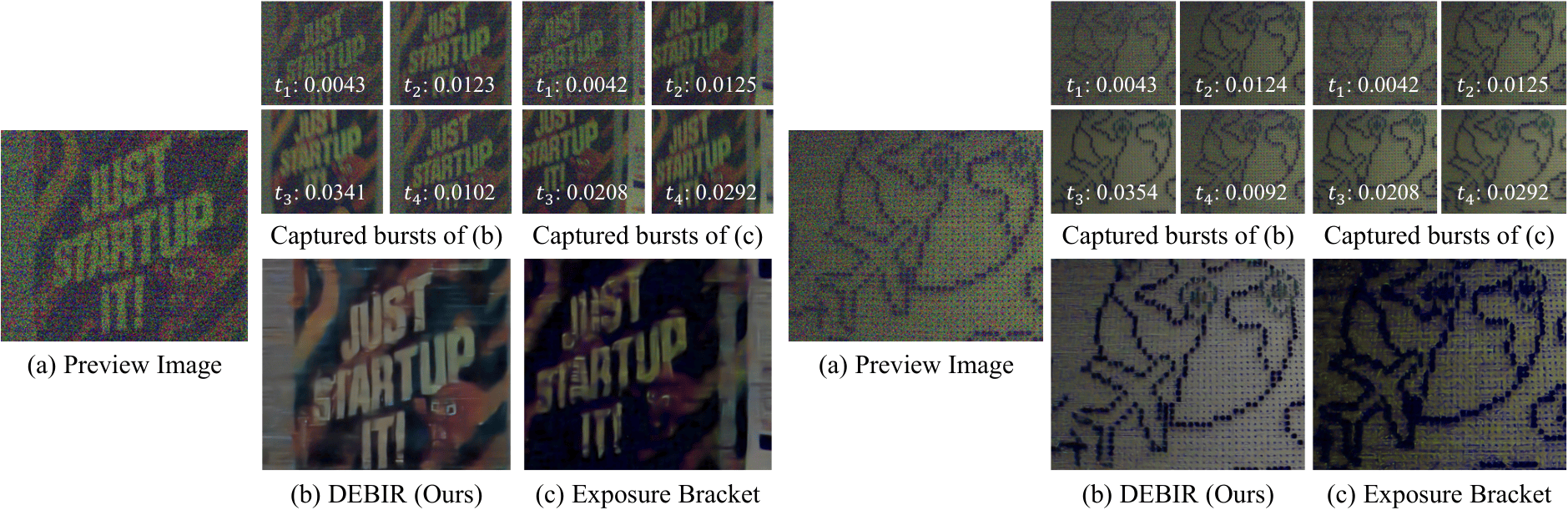
DEBIR enables effective burst image restoration by adaptively predicting an optimal exposure time for each burst image based on the shooting environment. To this end, DEBIR consists of a novel Burst Auto-Exposure Network (BAENet) and a burst image restoration network. BAENet determines the optimal exposure times for burst images, which maximize the restoration network performance, based on a preview image, current exposure settings, and motion information. The imaging system then captures burst images using these predicted exposure times, and the restoration network processes them to restore a clean, blur-free, and noise-free image.
Analysis
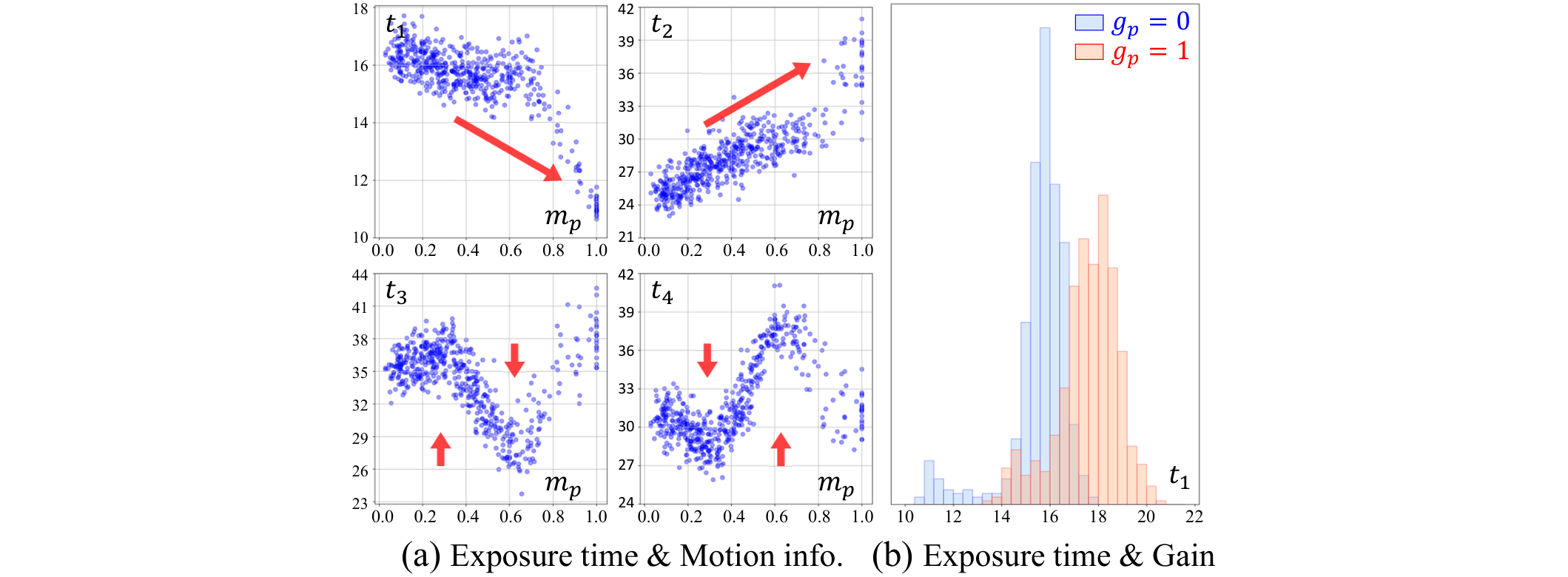 Analysis of predicted exposure times. (a) Scatter plots of exposure times of each frame and motion magnitude.
(b) Exposure time histograms of the first frame for the minimum and maximum preview image gains.
The unit of exposure times is 1/1920 sec., and preview image gain is normalized to [0,1].
Analysis of predicted exposure times. (a) Scatter plots of exposure times of each frame and motion magnitude.
(b) Exposure time histograms of the first frame for the minimum and maximum preview image gains.
The unit of exposure times is 1/1920 sec., and preview image gain is normalized to [0,1].
Results
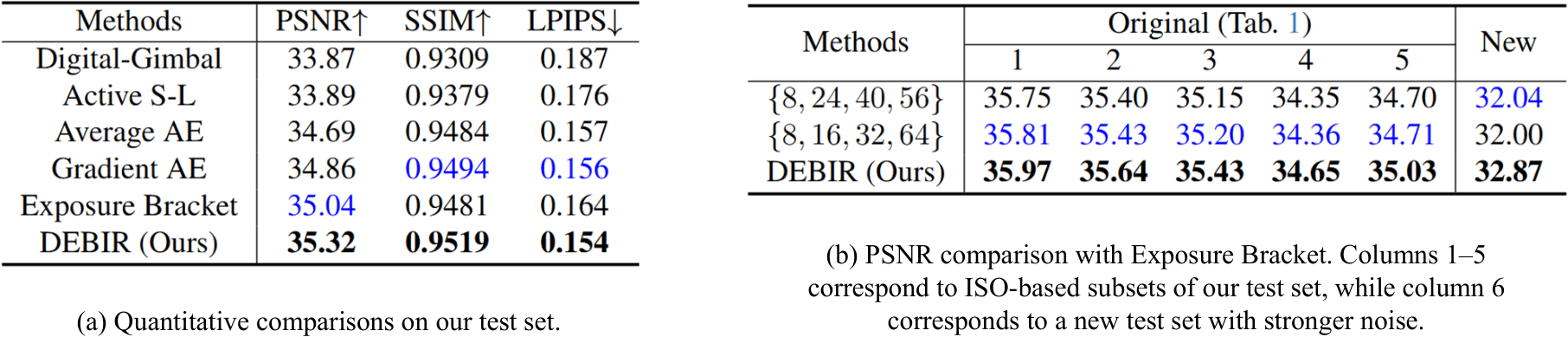
Quantitative
Qualitative
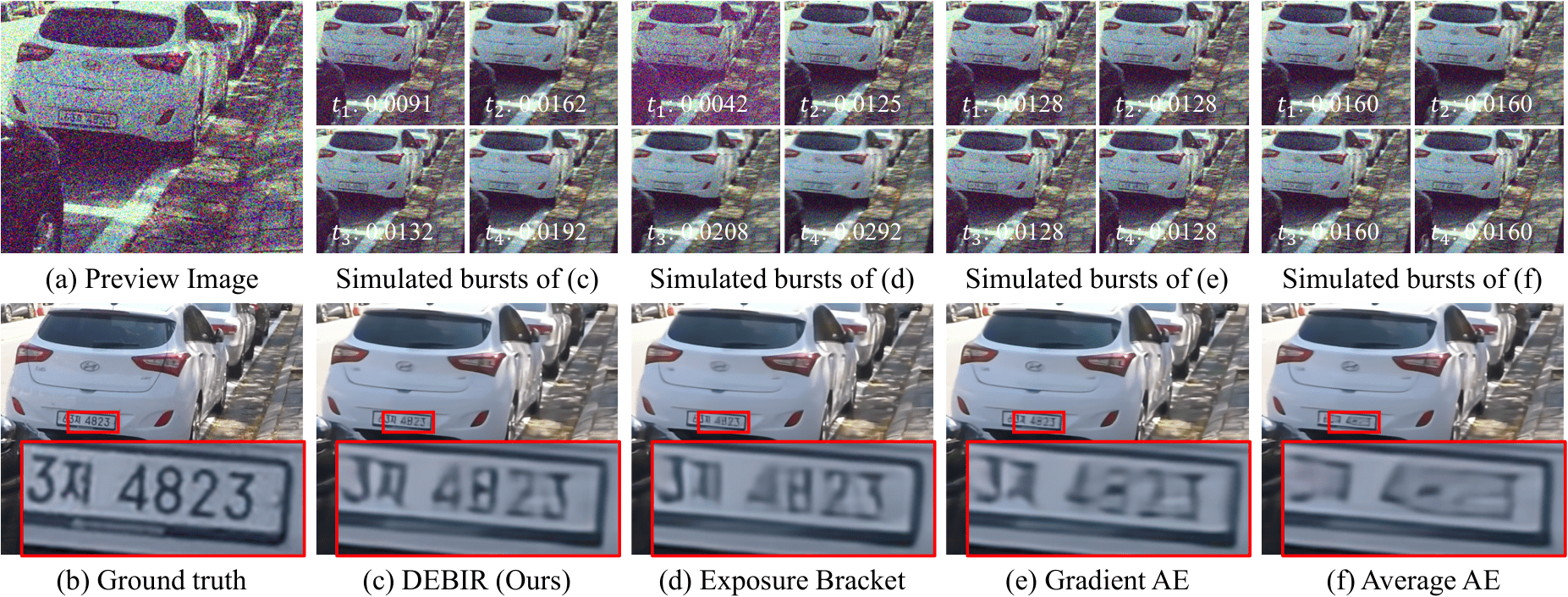
1. Synthetic
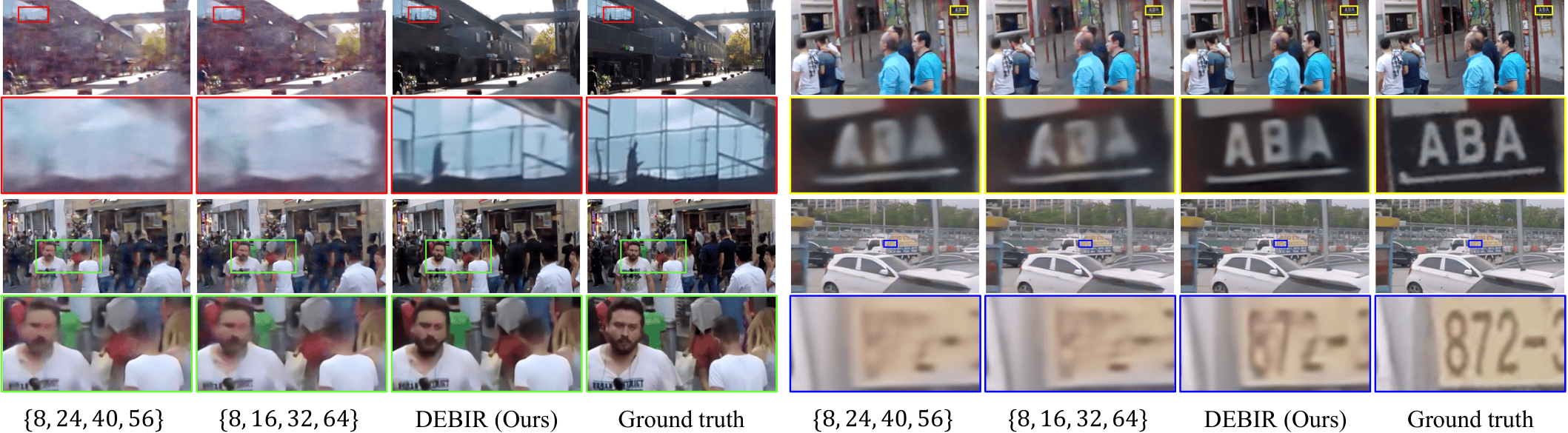
2. Real-world
Citation
@inproceedings{kim2026debir,
  title={Dynamic Exposure Burst Image Restoration},
  author={Kim, Woohyeok and Rim, Jaesung and Kim, Daeyeon and Cho, Sunghyun},
  booktitle={Proceedings of the IEEE/CVF Conference on Computer Vision and Pattern Recognition},
  year={2026}
}